A First Race Weekend, Followed Through the Paddock
A first race weekend can feel easier to follow with a simple paddock route: learn the public areas, recognize common terms, and watch routines unfold.
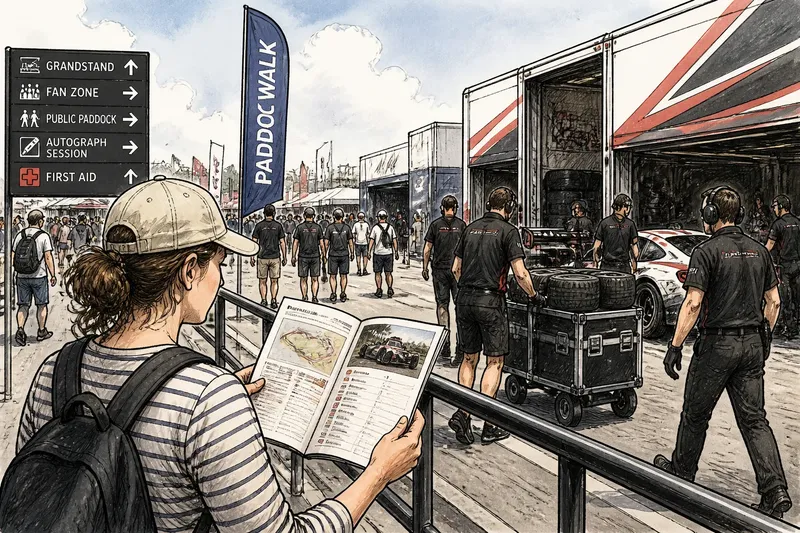
You arrive at the circuit with a day ticket, a paper program, and no idea whether “paddock” means somewhere you can enter. A first race weekend is easier to enjoy when you treat the paddock as a set of public-facing routines rather than a room you need special access to enter. From the spectator paths, you can learn the vocabulary, see how teams prepare, and notice the small rituals around a race without buying extra gear or trying to see everything.
Check the public map
Before leaving home, open the event’s spectator map and schedule. Look for areas explicitly marked as open to general admission: grandstands, fan zones, viewing banks, public paddock areas, and autograph or stage events. The word “paddock” can refer to different spaces at different series and venues, so use the map’s access markings rather than assuming the whole working area is open.
Choose a simple route with a few stops, not a circuit-wide expedition. A public paddock walk, one scheduled activity, and a place to watch the race are enough to give the day shape. Check how to reach the venue by transit or shuttle, where the permitted entrances are, and whether food and water can be brought in. A small bag and comfortable shoes are more useful than branded clothing or specialist equipment.
Keep the schedule as a guide, not a promise that every minute will run exactly on time. Practice sessions, support races, and public appearances may shift. Mark the events you most want to catch, then leave breathing room between them so a delay or an interesting display does not turn the day into a dash.
Start with the program
At the entrance, pick up a printed program if one is available, or keep the event schedule open on your phone. Find the series name, race classes, session labels, and track map. A race weekend may include more than one category of car, and each class has its own competitors and sessions. The program helps you connect a car you see in the paddock with the race it will enter.
Learn the basic schedule terms as you encounter them. A practice session gives drivers time on track before competition. Qualifying determines starting positions, though the exact procedure depends on the series. A race is the contest itself; a support race is a separate event held on the same meeting’s program. A parade lap or formation lap may bring the cars around before the start, but it is not the race’s opening competitive lap.
Notice which activities are open to everyone and which require a separate ticket, reservation, or credential. A fan zone might offer displays, interviews, or a stage program, while a team’s working area may be restricted. Stay on public paths and follow signs and staff directions. You can still get a useful view of the event without crossing a barrier or asking someone to make an exception.
Walk the public paddock
Take a slow pass through the public-facing paddock, if the event opens one. You might see transporters, team displays, parked race cars, sponsor boards, and crews moving equipment. A transporter is the vehicle or trailer that brings cars and team materials to the venue; the paddock is the event area where teams and vehicles gather. The exact layout changes by series, but public spaces are usually designed so visitors can observe without entering active work zones.
Watch where people pause and how signs divide the space. A display car may be set apart for close viewing, while a car behind a rope may be on show but not available to touch. A garage door, open or closed, is not an invitation to enter. If a team member is occupied, let them work. The best view is often from the marked public side, where you can notice the equipment and movement without getting in anyone’s way.
Listen for useful words without trying to memorize everything. A garage is the team’s working bay; a crew member may refer to a car’s setup, meaning its configuration for the circuit and conditions. A driver briefing is a meeting about event procedures and conduct, not a public presentation unless the schedule says otherwise. If a term is unfamiliar, jot it down and check the program later instead of interrupting a conversation.
Read the routines
Public-facing routines make the paddock feel legible. Cars may appear on display before a session, crews may move toward the garages as track time approaches, and drivers may have scheduled interviews or fan appearances. These activities show how the event is organized, but they do not reveal every private team decision. Treat what you see as a window onto the public side of the sport, not a complete account of what happens behind closed doors.
Imagine you reach a viewing rail while a crew is wheeling equipment toward a garage. You step aside, read the nearby sign, and notice the session listed on your program. The expected result is simple: you remain out of the crew’s path and can connect the movement with the day’s schedule, without guessing at the equipment’s purpose or asking for access.
Look for repeated cues: a marshal or event worker directing foot traffic, an announcement calling a session, or a crowd beginning to move toward a grandstand. These are practical signals for your own next choice. You do not need to interpret every radio message or technical display to follow the day. If commentary uses an unfamiliar phrase, focus on what is visible—cars entering the track, a session ending, or a line forming for a scheduled appearance—and return to the phrase later.
Choose one scheduled moment
Pick one public activity that suits your interests and timing. It could be a driver interview, a team display, a guided public tour, or an autograph session. Check the posted location and any access conditions before you walk over. Arriving with a little time to spare helps you find the entrance and understand where the line begins; it does not require you to spend the whole day waiting for a brief appearance.
At an autograph or meet-and-greet, follow the event’s queue instructions and be ready to move along when staff ask. A program, cap, or blank card is sufficient if the event permits signing; there is no need to buy a special item. If the line is long or the activity is full, use that time for a public display or a viewing spot instead. A schedule is most helpful when it leaves you free to change plans.
Not every visible routine deserves close attention. It is not worth lingering at a closed garage door, trying to decode technical screens from a distance, or chasing every driver between appearances. Those efforts rarely add much to a visitor’s understanding and can interfere with people working. Choose a public activity with a clear start and finish, then move on when it is done.
Find a race viewpoint
Before the main event, choose a spectator area based on what you want to observe. A grandstand may give a clear view of the start or a particular corner; a banked viewing area may show several sections of track but make distant action harder to read. Use the venue map and sightlines you can check from public paths. If you have a general-admission ticket, confirm which areas it allows you to enter.
Bring the schedule and, if useful, a simple circuit map. The map can help you identify where the cars are when commentary names a corner or sector. A sector is a portion of the lap used to divide timing information; you can understand the basic idea without tracking every number. If the event offers public commentary through speakers, listen for the session name, leader, and major changes in the order of the cars.
As the start approaches, notice the transition from paddock activity to track activity. Announcements, staff instructions, and spectator movement will tell you when to settle in. Stay behind barriers and use designated crossings if you need to move. For safety questions, follow venue instructions and ask event staff rather than relying on a general visitor’s guide.
Keep the day manageable
Plan a pause for food, water, and shade or shelter where the venue provides it. Crowds and weather can make even a modest route feel tiring, so check the event’s rules for what you may bring and where facilities are located. If you are attending with someone else, agree on a meeting point in case you become separated; choose a named public landmark rather than a vague spot such as “near the cars.”
Use your phone sparingly if you want to stay attentive. A few photos of signs, the circuit map, or a display can help you remember names, but filming every movement makes it harder to notice what is happening around you. Keep walkways clear, avoid blocking other spectators’ view, and respect signs about photography. If a screen or result sheet is available, check it during a natural break rather than constantly refreshing it.
Before leaving, glance at the schedule for the day’s last public activity and check the designated exit or shuttle information. A final walk through the public area can help connect the morning’s displays with what you saw on track. You do not need to collect every detail; a couple of terms and routines that now make sense are enough to make the next visit feel more familiar.
Questions visitors ask?
Can I enter the paddock with a regular ticket?
It depends on the event and the area: some venues open a public paddock, while garages and team workspaces remain restricted. Check the ticket information and spectator map before you go, and follow posted boundaries on site.
What should I wear to a race weekend?
Choose comfortable shoes and clothing suited to the forecast, since spectator routes can involve walking and standing outdoors. A cap, rain layer, or sunscreen may be useful depending on conditions; follow venue rules on bags and other items.
Do I need to know racing terms beforehand?
No. Learn a few words from the program as they come up, such as practice, qualifying, garage, and support race. You can follow the schedule and watch the cars without understanding every technical phrase.
How can I meet a driver?
Look for an event-listed appearance, autograph session, or public interview, and follow its queue and access instructions. Do not approach a driver or crew member in a restricted work area or assume an unscheduled appearance is open to visitors.
A first race weekend becomes easier to follow when you connect each public routine to the schedule: a display belongs to a team, a gathering may mark an appearance, and a crowd moving toward the stands often signals that track action is near. Keep the program handy and use the paddock as a place to notice those connections. That modest habit gives the day a clear thread without special access, extra equipment, or a packed itinerary.