Monocoque vs. Spaceframe: How Racing Chassis Arrange the Structure
Monocoque vs. spaceframe explained: see how each racing chassis carries loads, where its structure sits, and what to notice in a car’s design.
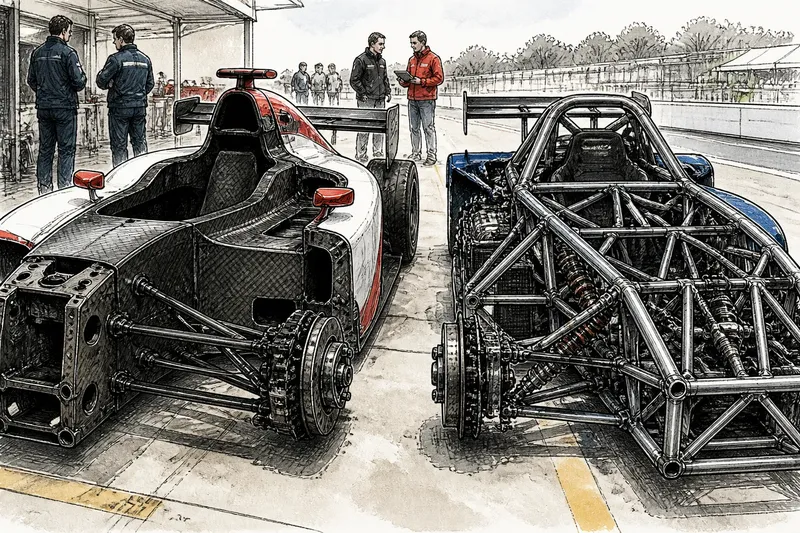
At a race paddock, two cars can have similar proportions and very different skeletons. Monocoque vs. spaceframe is a comparison of how each racing chassis organizes its structure: one makes the body shell carry much of the load, while the other builds a supporting framework from connected members.
Where the structure sits
A chassis is the vehicle’s main supporting structure. It holds the suspension, powertrain and bodywork in their intended relationships, while also carrying forces produced by cornering, braking and bumps. The chassis is not simply the visible exterior: body panels may be structural, decorative, or a mix, depending on the design.
A monocoque uses a shell as a major load-bearing structure. The word means “single shell,” though a real racing monocoque is assembled from multiple parts rather than formed as one uninterrupted piece. Its broad panels and joined sections work together to resist bending and twisting.
A spaceframe uses a network of members—often tubes—joined into a rigid framework. The arrangement of those members creates triangles and other shapes that resist distortion. Body panels can cover the frame, but they do not necessarily carry the main structural loads.
Reading a monocoque
Think of the monocoque as a stiff shell with a central occupant compartment and structural ends for attaching major components. In many modern racing cars, that shell is made from composite materials such as carbon-fiber laminates; other designs may use metal or different construction methods.
The shell’s strength depends on more than the material name. Panel shape, thickness, fiber direction, joints and local reinforcement all affect how forces travel. A wide, closed section can resist twisting differently from a flat panel, so the visible outline alone does not tell the whole story.
To read a monocoque, look for the boundary of the central tub, the openings for the driver and the points where suspension or engine structures connect. Those attachments show how loads enter or leave the shell. Front and rear structures may be separate assemblies, but their connection to the tub is part of the overall load path.
Reading a spaceframe
A spaceframe makes its structure easier to picture: members form a cage or lattice, and loads move through the connected pieces. A tube can carry tension or compression, while the geometry helps prevent the whole frame from folding sideways. A well-arranged frame is not just a collection of strong tubes; the connections and layout matter too.
Look through an open cockpit or beneath removable bodywork, where allowed, and the frame may be visible as intersecting members. Some designs use a simple rectangular outline with diagonal bracing; others have more elaborate layouts around the suspension, engine and driver. The tubes’ paths can reveal which areas need support and how designers preserve access to components.
Spaceframes commonly use steel tubing, though material and construction vary. A frame may be covered with nonstructural panels, or its panels may contribute some stiffness. The label “spaceframe” describes the basic structural idea, not every detail of how a particular car is assembled.
Load paths in motion
When a car turns, its tires push sideways against the road. Those forces pass through the suspension into the chassis, then through the structure toward the opposite side and the rest of the car. Under braking or acceleration, forces travel along different routes. The design goal is to keep the chassis sufficiently stiff and predictable so the suspension can do its intended work.
In a monocoque, loads spread through joined shell sections and reinforced attachment areas. In a spaceframe, they travel through members and their joints. Neither arrangement eliminates flex; each manages it through material, geometry and construction. Too much unwanted movement can disturb suspension behavior, while carefully controlled flexibility may be part of a design’s character.
Say you are watching two cars exit a slow corner. One has a composite tub and separate front and rear assemblies; the other has a visible tubular cage beneath its body panels. That observation suggests different structural layouts, but it does not tell you which car is faster. Tires, suspension settings, aerodynamics, power and track conditions also shape what happens on the circuit.
What the choice changes
A shell-based structure can combine a stiff central cell with carefully shaped surfaces and integrated mounting points. It can also make access and repair more involved when damage reaches a bonded or laminated area. A spaceframe can offer a clear, modular arrangement of members, with some sections easier to inspect or replace, but packaging a stiff frame around occupants and components takes careful design.
These are tendencies, not universal rules. A spaceframe can be highly sophisticated, and a monocoque is not automatically lighter, safer or simpler to maintain. Racing categories, manufacturing methods and design goals influence the result. For a specific car, the technical regulations and manufacturer’s information define what its terms mean.
For a spectator, the useful distinction is where the primary structure lives. If the shell itself carries major loads, think monocoque. If a connected framework of members does the main supporting, think spaceframe. A car may combine structural ideas, so treat these names as descriptions of a dominant approach rather than a complete inventory of every part.
Questions from the paddock?
Is a monocoque one piece?
Not necessarily. The name points to a load-bearing shell, but that shell can be built from joined panels and sections, with additional structures attached around it.
Does a spaceframe have body panels?
Often, yes. The panels may shape airflow and protect components without carrying most of the chassis loads, although some designs let panels add stiffness.
Which chassis is safer?
The label alone cannot settle that question. Safety depends on the complete design, materials, restraint systems, impact structures and the rules for the car’s class.
Can you identify the chassis from outside?
Sometimes, but bodywork can hide the important structure. A view of the cockpit, underside or technical description is more informative than the car’s exterior shape alone.
What not to infer
It is not worth trying to identify a chassis from a single body panel or assuming that visible tubes prove the whole frame is structural. Nor does a sleek exterior prove that a car has a monocoque. Look for the central load-bearing arrangement, then leave room for hybrid construction and class-specific design.
That simple distinction makes racing machinery easier to read: a monocoque distributes loads through a shell, while a spaceframe routes them through a connected framework. Once you know where to look, the car’s structure becomes part of the contest you can follow, not just something hidden under the bodywork.