What a Pit Stop Changes Besides the Tyres
Learn what a racing pit stop changes beyond tyre grip: track position, traffic, strategy choices and the risks that shape a car’s next stint.
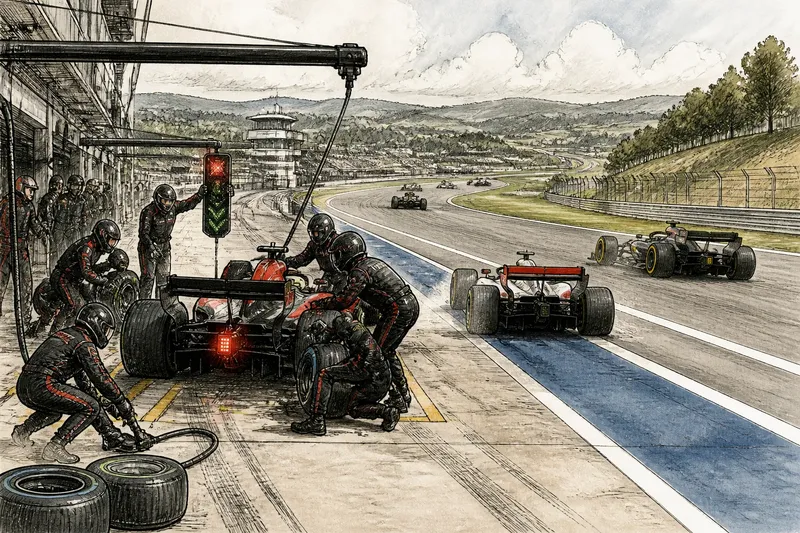
A car turns into the pit lane while its nearest rival stays on track, and the gap between them suddenly becomes hard to read. A racing pit stop changes more than tyre grip: it shifts a car’s position in the contest, its exposure to traffic and the options its crew can still choose.
What changes during a pit stop?
The visible service is only one part of a stop. The car leaves the racing line, follows the pit lane speed limit, reaches its assigned crew, receives the permitted service, and rejoins the circuit. Each part costs time that the driver must recover or manage against cars that did not stop at the same moment.
Tyres are often changed because their grip and condition affect how the car behaves. Depending on the series and its rules, a stop may also involve refueling, repairs, adjustments or a driver change. The permitted work differs between championships, so the stop’s purpose cannot be inferred from the wheel change alone.
Even without a mechanical change, the car’s immediate surroundings can be different afterward. It may rejoin behind slower traffic, emerge in clear air, or find a rival occupying the place it held before stopping. The service changes the car; the timing of the service changes its situation.
How does a stop affect track position?
A pit stop usually trades time now for a different position later. While one car is in the pit lane, another may pass it on track simply by continuing. That does not necessarily mean the passing car has gained an enduring advantage: it may still need to stop, and the first car may recover places once the order settles.
Commentators often distinguish track position from the order cars appear in during a pit sequence. Track position means where a car is relative to its rivals on the circuit. During staggered stops, the live order can be misleading because some cars have already completed their service and others have not.
Teams also consider the pit window, the period in which a planned stop can be made without abandoning the strategy. A stop near the beginning or end of that window can change which rivals are close by on rejoining. The driver’s target is not simply to reach the pit box quickly; it is to return to the race in a useful place.
Why stop before a rival?
A team may stop its car before a nearby rival to try an undercut. The early-stopping car receives fresh tyres, then tries to drive quickly while the rival remains on older ones. If the rival stops afterward and rejoins behind, the first car has gained position through timing rather than a pass on the track.
The tactic depends on more than tyre age. The fresh set needs to work promptly, the car must have clear track or a manageable gap to traffic, and the driver must make effective use of the laps before the rival responds. A slow out-lap, a crowded rejoin or a rival that stops immediately can blunt the attempt.
The reverse choice is to stay out longer, sometimes called an overcut. A driver may continue on usable tyres while a rival stops and then try to build enough time before making their own visit. This can suit a car that is comfortable on its current tyres or one that would otherwise rejoin into traffic. It can also leave the driver vulnerable if grip fades or the rival’s fresh tyres produce a strong advantage.
What does traffic change?
Traffic is the group of cars a driver encounters that may be slower, on a different strategy or fighting for its own position. A stop can place a car behind traffic that it would have passed by remaining on track. That costs more than a few moments of patience: the driver may lose the chance to build a gap, defend from a rival or bring new tyres up to working condition smoothly.
Clear air is open track without a nearby car disrupting the driver’s pace. Teams value it because the driver can concentrate on their own laps rather than repeatedly closing on and passing other cars. But staying out to preserve clear air has a limit: the current tyres and the remaining race still matter, and a useful gap can disappear if a rival’s pace improves.
Imagine a car approaching its planned stop while a slower group is circulating near the pit exit. Its crew could call it in immediately, but the rejoin may place it behind that group. If the tyres remain suitable and the rules allow flexibility, waiting for the cars to separate could offer a cleaner return; the expected observable result is a more open section of track, not an automatic gain in position.
What if a safety car appears?
A safety car or similar neutralization changes the cost of a pit stop because the field is moving more slowly and bunching together. A service that would have cost substantial track position under green-flag racing may become easier to absorb. That makes a stop during neutralization attractive, but it does not make the choice automatic.
The driver may still rejoin behind several cars, and rivals may make the same decision. A team must also consider whether the car can reach the pit entry safely and whether the rules permit the intended service at that moment. The field’s compressed order can reduce gaps that a driver had built carefully before the neutralization.
For viewers, the useful question is not just “Who pitted?” but “Who was already committed to stopping, and where did each car rejoin?” A stop can look like a sudden leap in the standings while the race is neutralized, yet its real value becomes clearer when racing resumes and the cars can use their tyres and pace.
Can a pit stop change the car?
Yes. A stop can change the car’s setup or condition when the rules allow adjustments or repairs. A crew might address a damaged part or make a permitted change that affects how the car handles. Such work can help the driver manage the next stint, but it also takes time and may not remove every effect of the original problem.
Some changes are less visible than a tyre swap. A car may leave with a repaired body panel, a different front-wing setting or a corrected issue that had made it difficult to drive. What the crew can alter depends on the series regulations and the manufacturer’s instructions for the equipment; those determine what work is allowed and appropriate.
A stop can also change the driver’s task without changing the car’s hardware. After rejoining, the driver may need to protect a position, pass traffic or preserve tyres for later. The same car, on the same broad strategy, can therefore face a very different problem because of where it returns to the circuit.
How should viewers read a stop?
Watch the stop as a decision with consequences rather than a short service scene. Keep track of the rival being targeted, the cars likely to stop later, and the traffic near the pit exit. Then compare the order after those rivals have also made their visits; only then is the positional effect easier to judge.
Listen for whether the team describes the stop as planned, reactive or caused by a problem. A planned stop usually fits an intended sequence. A reactive call responds to a rival or changing conditions. A problem-driven visit may sacrifice strategy to restore the car’s ability to continue effectively.
It is not worth trying to calculate every pit-lane second from a broadcast graphic. The more useful habit is to ask what the car gives up by stopping, what it gains, and which options remain afterward. That keeps attention on the contest rather than treating every change in the live order as a settled result.
A racing pit stop is best understood as a transfer: the team spends time and track position to change the car’s condition or its strategic timing. The clue to its value comes after the car rejoins, when traffic, rival decisions and the driver’s next available choices reveal what the stop actually altered.